Seven Fake DOIs, One Famous Paper: A Warning for Journal Editors
By Thu Tran
TL;DR: A duplicate DOI for one of the most cited papers in machine learning, Attention Is All You Need, is sitting in Crossref right now, registered by a publisher with no connection to the field, dated 2025, under the real paper's exact title and all eight original authors. This is not a single stray entry: a plain-text title search on Crossref returns seven fake duplicates from that same publisher occupying the top seven results, with the real 2017 paper not appearing anywhere in the first thirty. If a reviewer, or an AI tool drafting a manuscript's references, had cited the fake instead of the real paper, nothing about checking one database would have caught it. The fake entry is correctly formatted and resolves through a redirect chain, only falling apart once you check whether independent sources agree. This is not a hypothetical AI-hallucination story; it is a live registration you can verify yourself. Here is what it means for pre-publication review, and how cross-provider consensus catches it.
Why this is an editorial risk, not just a technical curiosity
A hallucinated citation in a student essay is a grading problem. A fabricated citation that makes it into a published, peer-reviewed manuscript is a different kind of problem entirely — it's a correction notice, an uncomfortable exchange with the authors, and a mark against the journal's own review process, not just the author's. The citation itself doesn't have to be central to the paper's argument to matter here; a fabricated reference sitting quietly in a background paragraph is still a fabricated reference once the manuscript is in print, and it's the journal's name attached to having missed it.
That's the frame worth holding onto for what follows: this isn't about whether AI occasionally invents sources. It's about a specific, real, currently-live case of citation fraud that would pass a single-database check — the kind of check that's easy to assume is "good enough" during a routine pre-publication reference pass.
It's not one bad entry — it's seven
We previously wrote up the full technical mechanics of this case: a duplicate DOI, 10.65215/ctdc8e75, registered under the exact title and all eight author names of Attention Is All You Need (Vaswani et al., 2017), dated 2025, by a publisher called "Shenzhen Medical Academy of Research and Translation" — an entity with no discernible connection to machine learning research. The DOI resolves through a two-hop redirect to a page on langtaosha.org.cn that has since been taken down and now returns a 404. The redirect dying doesn't clean anything up: the registration and its metadata persist in Crossref regardless of whether the page behind it is still live, which is exactly why checking the database record itself — not just clicking through and seeing if a page loads — is the part that matters.
What we didn't cover in that post is the scale of it. A plain-text bibliographic search on Crossref for this paper's title doesn't surface one fake entry buried somewhere in the results — it surfaces seven duplicate fake entries from the same publisher, occupying the top seven search results. The real 2017 paper doesn't appear anywhere in the first thirty. If you were searching Crossref by title alone, as a manual spot-check or a simple lookup tool might, you would have to actively dig past a wall of fabricated entries to find the paper you were actually looking for — and most naive checks stop well before that.
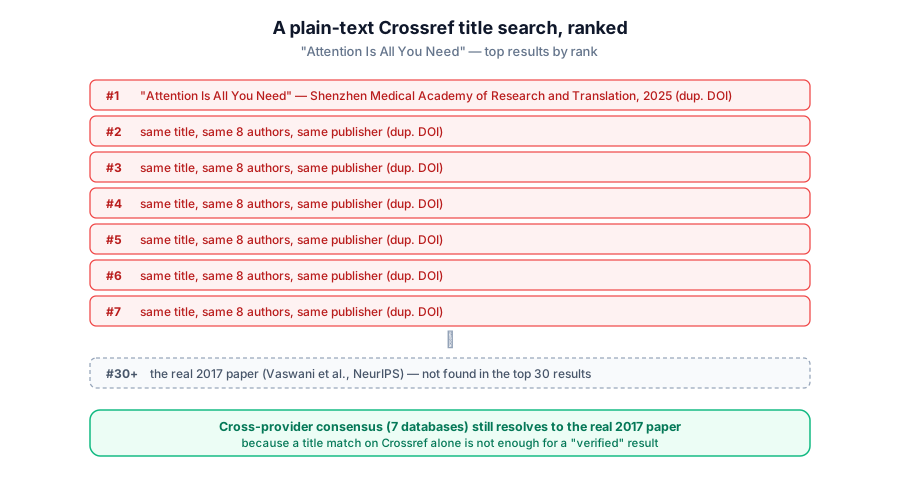
If you want the exact curl command to pull the Crossref record yourself and see this directly, that's in the original technical writeup.
How this gets caught before it reaches print
The reason a single-database check misses this is structural, not a fluke: Crossref aggregates what publishers submit, it doesn't independently fact-check every registration. A byte-identical title with copied author names is enough to pass a naive title match, seven times over, in this case.
AccuraCite's verification doesn't stop at one source. Every citation is checked against six databases at once — OpenAlex, Crossref, Semantic Scholar, PubMed, DBLP, and arXiv — and a result is only marked verified when independent sources agree on it. In this case, that's what makes the difference: Crossref alone carries the fake entries, but the other providers independently agree on the real 2017 paper, and that consensus is what overrides a single poisoned source instead of being fooled by it.
That's meant to run as a normal part of reviewing a manuscript's reference list — a per-manuscript check when a submission comes up in your queue, not a one-time sweep of an entire archive.
What this pattern means beyond this one paper
We can't say how common duplicate-DOI registration is across the literature — we found and verified this one case directly, not a broader sample. But the incentive behind it generalizes in an obvious direction: a fake DOI is only worth registering if something downstream might cite it, and a highly-cited paper attracts far more of that traffic than an obscure one. The more citable a paper already is, the more attractive a target it becomes for exactly this kind of duplicate registration — which is the opposite of the assumption most reviewers and editors work from, that a famous, heavily-cited paper is the safest thing in a reference list to leave unchecked.
A few structural features are common to this kind of fake registration, and worth knowing even without a tool in hand:
- A registration date that postdates the real paper by years, sometimes by a wide margin, since the fake exists to capture citation traffic to an already-established paper rather than to publish new work.
- A publisher with no visible track record in the field the paper belongs to — a medical-research-branded publisher registering a DOI for a machine learning paper, for instance, is a mismatch worth noticing on its own.
- A landing page that's since gone dark, or redirects through more than one hop before resolving — the DOI record itself persists in the registry regardless of whether the page behind it still loads.
How to check a DOI's registration yourself, without a tool
If you want to spot-check a specific reference rather than run a full bulk verification, Crossref's own metadata is public. Querying https://api.crossref.org/works/<DOI> returns the registered title, author list, publisher, and registration date as JSON — worth comparing against what you'd expect: does the publisher match the field, does the registration date make sense relative to when the paper claims to have been published, do the authors match a paper you can independently find elsewhere. None of this requires special access; it's the same public API the original technical writeup used to pull this case's record directly. The limitation is that this only checks one database at a time — which is exactly the gap that let seven fakes outrank the real paper on Crossref alone, and exactly why cross-provider consensus across independent sources is what actually closes it.
Where this fits for editors
If you're evaluating whether something like this belongs in your own pre-publication review process — what the actual output looks like, how it fits into a rolling review workflow without requiring you to batch-process your whole backlog — that's what we cover on our page for journal editors and publishers, including a sample report showing real Verified/Mismatch/Hallucinated results.
FAQ
Is the fake DOI still active? The registration is still live in Crossref as of this writing. The landing page it redirects to has been taken down, but that doesn't remove the DOI record — Crossref registrations don't automatically expire or get cleaned up just because the publisher's site goes offline.
Could this happen to other well-known papers, not just this one? We can't say how widespread this specific pattern is beyond the case we found and verified directly. What we can say is that a highly-cited paper is a more attractive target for this kind of duplicate registration than an obscure one, simply because a citation to a "real-looking" DOI is worth more the more well-known the original paper is.
Where can I check the technical details myself?
The original post has the full breakdown, including the exact curl command against Crossref's public API, the redirect chain, and the fix we shipped in our own verification logic.
If a manuscript only cites the real DOI, does this affect it at all? Not directly — a citation to the genuine 2017 paper's real DOI resolves and verifies normally. The risk is specifically for a citation drafted from a title-only search (by a person or an AI tool) that happens to pick up one of the duplicate entries instead of the original, which is a plausible failure mode precisely because the fakes currently outrank the real paper in a plain-text Crossref search.
What should an editor do if they find a similar duplicate registration for a different paper? Crossref has a process for reporting incorrect or fraudulent metadata directly to them for correction or retraction of the registration. It's also worth flagging internally so other editors at your venue know to double-check citations to that specific paper until the registry is cleaned up.