How to Check If ChatGPT's Citations Are Real Before You Submit
By Thu Tran
TL;DR: You asked ChatGPT or Claude to help draft your literature review or reference list, and it handed back a set of citations that look completely legitimate — correct formatting, plausible author names, real-sounding journals. Some of them are probably fine. Some are quietly fabricated: a DOI that resolves to nothing, an author who never wrote that paper, a journal issue that doesn't exist. LLMs don't look papers up before citing them; they predict what a citation should look like, which is exactly why a fake one reads as confidently as a real one. Manually re-Googling every reference before you submit a paper or thesis is slow, and it's easy to skip the ones that look obviously fine. This post explains why AI-generated citations fail this way, what a citation check actually needs to verify beyond formatting, and how to run every reference in your own bibliography through one pass before you hand it in, instead of hoping the ones you skipped happen to be real.
This is the individual, check-your-own-paper version of this problem. If you're a professor or TA checking a whole stack of student submissions instead, that's a different workflow — see how to check your students' citations for AI hallucinations.
Why ChatGPT's citations can't be trusted at face value
ChatGPT and other LLMs don't look papers up when they write a reference. They predict text that statistically resembles a citation, based on patterns learned from real bibliographies during training. That's the whole mechanism — and it's why a hallucinated reference doesn't look uncertain or half-formed. It looks like a normal citation: a plausible author list, a journal name that could easily exist, a DOI-shaped string in the right format.
None of that requires the paper to actually exist. The title might not match any real publication. The listed authors might never have written together. The DOI might resolve to an entirely different paper, or to nothing at all. You can't tell which of these is true by reading the citation — it's formatted the same either way.
What "checking" a citation actually needs to catch
A citation can fail in more than one way, and they call for different reactions:
- Hallucinated — the citation doesn't exist in any indexed academic database. No matching title, no DOI, nothing. The clearest sign this reference was never actually consulted.
- Mismatch — something real is being cited, but a detail is wrong: the year, the author list, the journal, or the DOI itself. Sometimes ChatGPT blended two real papers into one citation; sometimes a DOI is stale or points to the wrong record entirely.
- Verified — the source exists, and its metadata and DOI both check out. No action needed on that one.
A citation that's correctly formatted can land in any of these three categories — formatting tells you nothing about which one you're looking at, which is exactly why a quick visual read-through of your bibliography doesn't catch much.
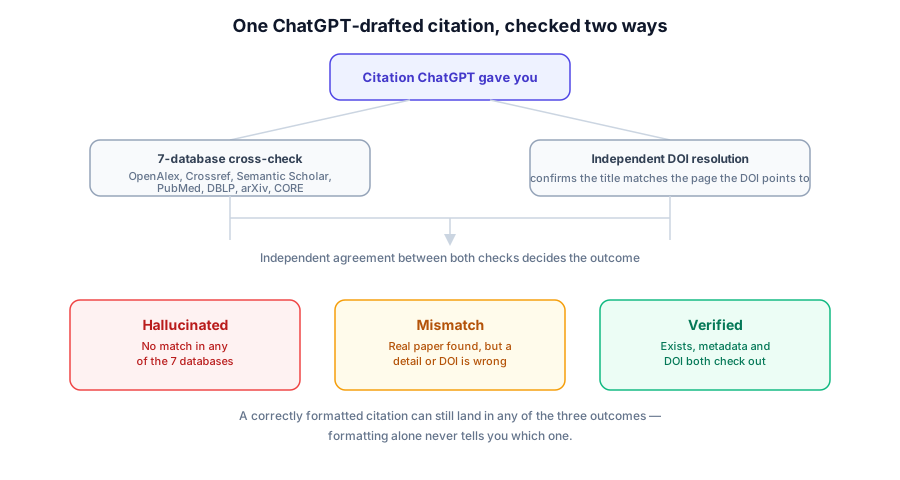
Common ways ChatGPT-drafted citations fail
Not every bad citation fails the same way, and recognizing the pattern helps you know what you're looking at once a check flags it:
- Two real papers blended into one. The title comes from one paper, the author list or year from another — each half is real and independently verifiable, but the combination as cited doesn't correspond to any actual publication.
- A DOI copied from the wrong neighbor. The citation's title and authors are correct, but the DOI resolves to a different, often adjacent paper — plausible if the model generated the reference list in a batch and misassigned one DOI to the wrong entry.
- A confidently specific but nonexistent venue. A "special issue" or conference track that sounds exactly like the kind of thing a real journal would run, attached to a real-sounding title, with nothing behind it in any index.
- A real author, a paper they never wrote. The named researcher is real and publishes in the area — the specific title attributed to them isn't part of their actual body of work.
Formatting won't distinguish any of these from a fully verified citation. That's the whole reason a check has to go against real databases rather than just checking whether a reference "looks" complete.
Step-by-step: checking your own citations before you submit
- Paste your reference list into AI Citation Checker, in whatever format it's already in. Drop in whatever ChatGPT, Claude, or another LLM drafted for you — a full bibliography, not just one entry at a time. It detects APA, MLA, Chicago, Harvard, IEEE, and Vancouver automatically, accepts BibTeX, RIS, PDF, or raw text, and if your citation style isn't in that list, paste it in anyway — it still gets parsed rather than rejected.
- Every reference is cross-checked at once against six databases — OpenAlex, Crossref, Semantic Scholar, PubMed, DBLP, and arXiv — looking for independent agreement between sources rather than trusting whichever one answers first. More on how the checks work on the How It Works page.
- Each DOI is resolved independently, confirming the title on the page it points to actually matches your citation. This is what catches a citation with a real-looking but stale or mismatched DOI — a common way a fabricated reference half-passes a naive check.
- Read the flagged list, not your whole bibliography again. You get a verified/unverified result per reference, so you go straight to the ones that actually need attention instead of re-reading citations that already checked out.
- Replace what's flagged. Unverified or likely-hallucinated citations come with a suggested real paper, so you're not starting your search over from scratch for each one.
What it costs to check
Citation checks draw from a shared credit pool, and verifying one citation costs 1 credit. The free plan includes 50 credits a month — enough to check 50 references without spending anything. If you're checking longer bibliographies more often, the Pro plan gives 1,000 credits/month for $9.99, and Bulk gives 10,000 credits/month for $19.99. There are also 7-Day Passes if you just need to get through one paper or thesis this week: 350 credits for $4.99, or 3,000 credits for $9.99.
If you're starting from a claim with no citation yet, rather than a reference ChatGPT already gave you, finding a real source that supports it is a different tool — see how to find sources for a claim AI can't back up.
What to do with a mismatch, not just a hallucination
A hallucinated citation has one fix: replace it. A mismatch is less obvious, because something real is genuinely behind it. Before swapping it out, check whether the mismatch points to a source close enough to what you meant to cite — sometimes the real paper you were actually thinking of is one author-name or one year away from what got written down, and the fix is correcting the reference rather than finding a new source entirely. Other times the mismatch reveals that no real paper actually says what you needed it to say, in which case it needs the same replacement treatment as a full hallucination. Either way, don't leave a flagged mismatch in a final submission on the assumption that "something real is in there somewhere" is good enough — a reader or reviewer checking the DOI will hit the same discrepancy you did.
FAQ
Does this replace fact-checking whether a source actually says what I claimed? No — a verified citation means the paper exists and its metadata matches what you cited. It doesn't confirm the paper's findings support the specific point you're making in your text. That part is still on you to read and check.
What if ChatGPT found the source through a live web search instead of generating it from memory? It's still worth checking. A web-search-enabled LLM can find a real page and still misattribute a detail when it writes the citation — the wrong year, the wrong author order, a DOI copied from an adjacent result. The check runs the same way regardless of how the citation was originally produced.
Is this the same thing as a plagiarism checker like Turnitin? No. A plagiarism checker compares your text against a corpus of existing writing to see if it was copied from somewhere. It doesn't check whether the sources in your reference list actually exist or say what you claim — that's a separate question a similarity score was never built to answer.
Can I check citations in different formats — APA, MLA, IEEE? Yes. It detects APA, MLA, Chicago, Harvard, IEEE, and Vancouver automatically, and accepts BibTeX, RIS, PDF, or raw pasted text — including exports from EndNote, Zotero, and Mendeley. Don't see your exact format in that list? Paste it in anyway; it still gets parsed rather than rejected.
I used a citation manager like Zotero or EndNote — doesn't that already guarantee my references are real? No. A citation manager formats and organizes references correctly; it doesn't verify that the underlying source exists. If you imported a ChatGPT-drafted citation into Zotero, or pulled in a DOI that turns out to be mismatched, the manager will format it beautifully and pass it through unchanged — formatting correctness and factual correctness are separate questions.
What if I only used ChatGPT to help me find sources, and wrote all the citations myself afterward? Still worth checking, especially if you copied a title or DOI from the conversation without independently confirming it. The failure mode isn't limited to citations an LLM fully drafted — it also applies to a real source's details getting slightly garbled in the process of being relayed back to you.