How to Find Sources for a Claim When AI Can't Back It Up
By Thu Tran
TL;DR: Ask ChatGPT or Claude to find me a source that supports this claim, and it will confidently hand you one — sometimes a citation that doesn't exist at all, sometimes a real paper whose title matches your topic but whose actual findings say something different, weaker, or even the opposite of what you're arguing. Neither failure looks uncertain from the outside; both read as confident, well-formatted citations. A plain keyword search on Google Scholar has a related but distinct problem: it ranks results by how closely your search terms match a title and abstract, not by whether a paper's findings genuinely support your specific statement, so you still end up reading through abstracts by hand to separate real support from papers that merely mention the same topic. This post walks through why both failure modes happen, what actually supporting a claim requires structurally, and how to search abstract-level evidence against real, verifiable academic databases instead of guessing.
If you're starting from a paper that already has citations you're not sure about, checking those first is worth doing before you go source-hunting — verifying an existing citation and finding a new one are different problems, and it's faster to know which one you actually have.
Why asking an LLM directly for a citation doesn't work
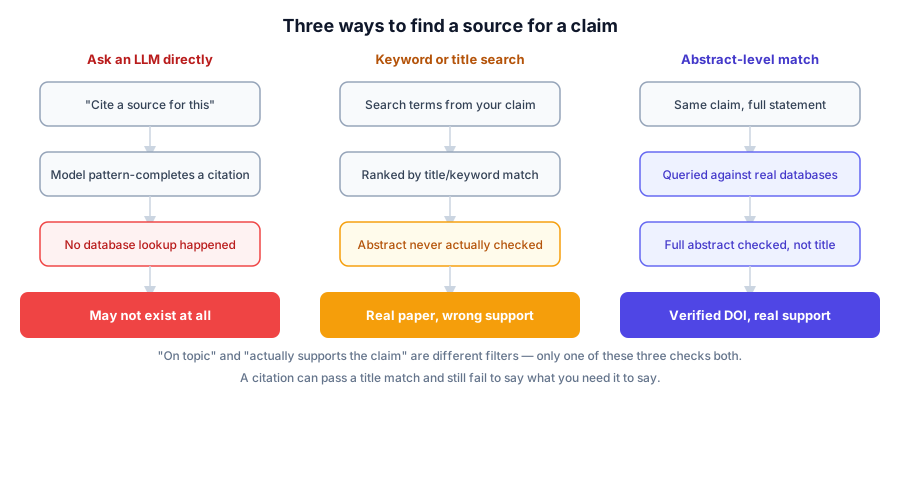
Finding a source is a fundamentally different task than verifying one you already have, and it fails differently. When you ask an LLM to verify an existing citation, it can at least be wrong about a real, checkable thing. When you ask it to find you a source, there's nothing to check against yet — the model is generating a citation from its sense of what a plausible reference for your topic would look like, the same way it generates plausible-sounding prose. Nothing in that process necessarily involves looking anything up.
That's why LLM-generated citations tend to be stylistically perfect and substantively unreliable: correct author-name conventions, a journal name that sounds right for the field, a formatting style that matches what you asked for. None of that requires the paper to exist. A hallucinated citation doesn't come with a warning label — it looks exactly as confident as a real one, which is precisely what makes it dangerous to hand in or build an argument on without checking.
Why a keyword search isn't the fix either
Google Scholar, PubMed's search bar, and similar tools solve a different problem than the one you actually have. They're built to answer "what's out there on this topic?" — ranking results by how closely your search terms match a paper's title, abstract, and keywords. That's a reasonable thing for a search engine to optimize for, and it's also not the question you're asking when you need a source for a specific claim.
A title match is not the same thing as support. A paper titled "Remote Work and Employee Productivity" might report that remote work decreases productivity in your search results, right alongside one that found the opposite — both are strong keyword matches, and a title-ranked search has no mechanism for telling them apart before you open and read each one yourself. The search did its job; it just wasn't the job of confirming the paper backs your specific statement.
What "a source that supports this claim" actually requires
A citation that genuinely backs a specific statement has to clear three separate bars, and most tools — and most manual searches — only clear the first one or two:
- It exists and is verifiable. A real DOI, indexed in an actual academic database — not just a citation that's formatted correctly and sounds plausible.
- It's on topic. The paper is actually about the subject your claim addresses, not just adjacent to it. This is the bar a keyword search clears.
- Its findings genuinely support the specific statement. Not the general topic — the actual claim, including its direction and scope. A paper on the same subject that reports the opposite finding is on-topic and still doesn't support you.
Skipping the third check is how a citation ends up "supporting" an argument it actually contradicts, and it's the check neither a direct LLM ask nor a plain keyword search performs.
Step-by-step: finding real sources for a claim
- Paste your statement into Find Sources for a Claim. Drop in a thesis, claim, or paragraph and mark each spot that needs a source with
\cite(n)— no need to draft search terms yourself. - The tool queries OpenAlex, Crossref, and Semantic Scholar, then reads the full abstract of each candidate paper — not just its title — using an LLM specifically prompted to retrieve real sources rather than draft plausible-sounding ones. Papers that share keywords with your claim but don't actually support it are filtered out before you ever see them. More on the retrieval pipeline on the How It Works page.
- Review what comes back. Each match includes the source abstract, a verified DOI, and a short explanation of how it supports your specific claim — so you can judge the match yourself instead of taking a single label on faith.
- Export what you accept. Matches you keep convert straight to a BibTeX entry, ready to drop into your reference manager.
- If nothing genuinely supports your claim, you're told that directly rather than handed a loosely related paper to fill the gap — and the search is refunded from your monthly quota automatically.
What it costs to run
Finding sources draws from the same credit pool as citation verification, just at a different rate: 4 credits per claim search versus 1 credit per citation verified. The free plan includes 50 credits a month — enough for a dozen source searches, more if you mix in verification — and the Pro and Bulk plans scale up from there for heavier research or coursework loads.
If you're starting from citations ChatGPT already gave you, rather than a claim with no source yet, checking whether those are real is the faster next step — see how to check if ChatGPT's citations are real before you submit.
FAQ
Is this different from just asking ChatGPT to search the web for a citation? Yes. A web-search-enabled LLM can find a real, indexed page and still misjudge whether its contents actually support your claim, because the check that matters — does this abstract's finding genuinely back this specific statement — isn't guaranteed by "the page is real." Abstract-level matching runs that check explicitly and shows you the reasoning, rather than folding it into a confident-sounding answer.
What if my claim is narrow or unusual and nothing in the literature actually supports it? That's a real and useful outcome, not a failure of the tool. You'll be told no genuine match was found instead of getting a loosely related paper padded in to fill the result, and the search is refunded automatically so a null result doesn't cost you a credit.
Can I use this for a literature review with many claims at once, not just one statement?
Yes — mark every spot that needs a source with \cite(n) in the same pasted text, and each one is searched and matched independently, so you get a full set of candidate sources back in one pass instead of running the tool once per sentence.